

I’ve been seeing way too many posts on Reddit from people trying to buy Debacterol and Oralmedic on eBay.
If you’re in that headspace, I get it. Mouth pain makes “relief now” feel more important than everything else.
But when the answer is “you can’t, not normally,” and the next step becomes eBay, the risk profile changes fast.
So I asked my father-in-law about it. He’s a doctor, and his reaction was not “that doesn’t work.” It was: the supply chain is the danger.
When the product you’re trying to buy is essentially a corrosive chemical cautery that’s applied to delicate mouth tissue, “maybe it’s expired” or “maybe it was stored wrong” stops being a minor concern.
That conversation pushed me to dig deeper. This post is what I learned.
Important (Medical disclaimer)
This article is informational only. Mouth ulcers have many causes. If you are not sure what a sore is, if it lasts more than 2 to 3 weeks, or if you get severe or frequent ulcers, get evaluated by a clinician or dentist.
The short version
- Debacterol and Oralmedic are not “numbing gels.” Their “stop pain fast” effect comes from chemical cautery/desiccation (controlled chemical injury).
- In the U.S., the regulatory story is messy. Debacterol appears with “unapproved drug” labeling status, and Oralmedic is marketed abroad but not FDA-authorized for U.S. retail sale.
- Buying caustic, technique-sensitive products on eBay is uniquely risky. Even if the chemistry can help some people, the downside of “wrong product / degraded product / missing instructions / poor storage” is higher than with most OTC items.
- There are safer U.S.-available alternatives (OTC for comfort, and clinician-supervised options for faster relief or frequent disease).
Why people want these so badly
If you’re dealing with a canker sore that makes eating feel like punishment, the appeal is obvious: one application, pain drops fast.
Most U.S. OTC options are in a different category:
- they numb (briefly)
- they coat (sometimes)
- they wait (inevitably)
If you want the practical baseline first, start here: Most Common Over-the-Counter Canker Sore Remedies (With Examples)
What Debacterol and Oralmedic actually do (plain language)
Debacterol and Oralmedic are best understood as chemical cautery/desiccation agents.
They’re designed to touch a small spot briefly and create a controlled local injury that can:
- reduce exposed nerve endings at the ulcer surface (less pain)
- create a temporary “coagulated” layer over the lesion (a barrier)
That mechanism is also the reason they are not casual products. The “dose” isn’t just how much—it’s also where it touches, how long, and whether it spreads.
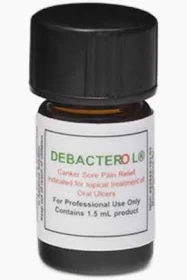
Debacterol is a chemical cautery agent that comes up frequently in canker sore forums. It is not the same category as a numbing gel.
Why they’re hard to buy in the U.S. (without getting “legal-y”)
I’m not a lawyer, and this is not legal advice. But the basic regulatory signals are worth understanding because they explain the “why can’t I just buy it at CVS?” feeling.
Debacterol: shows up with an FDA “unapproved drug” status
Debacterol’s DailyMed label includes a marketing status indicating it is an unapproved drug, and it carries the explicit disclaimer that FDA has not found it safe and effective and has not approved the labeling.
This is also where people get confused: a product can have an NDC listing presence without being FDA-approved. FDA is explicit that NDC listing does not mean approval.
Oralmedic: sold abroad, but not FDA-authorized for U.S. retail sale
Oralmedic is sold as a medicine in some non-U.S. markets and is widely discussed online, but the product is not FDA-authorized for U.S. sale. That’s a big reason it keeps appearing in cross-border listings and secondary markets.
The supply-chain point (why eBay is the part that should scare you)
Here’s the doctor-style framing my father-in-law gave me, translated into normal language:
If you buy something on a marketplace, you are not just buying a product. You are buying its history.
With a corrosive oral cautery product, that history matters more than usual.
What can go wrong in a degraded or unknown supply chain
- Wrong product / counterfeit / substituted contents: the label is not a chemistry test.
- Expired stock: for some products, expiration is about potency; for others, it’s also about stability and packaging integrity.
- Improper storage: heat, freezing, and long transit can matter—especially when liquids, applicators, or seals are involved.
- Leaking/corroding packaging: caustic liquids can damage packaging (and nearby items) if seals fail.
- Missing or altered instructions: technique and warnings are part of safe use. Marketplace listings are not a replacement for an instruction leaflet.
- Language/labeling mismatch: if you can’t read the warnings, you’re guessing.
This is why “I’m sure it’s fine” is not a great mindset here. These aren’t vitamins. The mechanism is controlled damage.
The safety problem is not theoretical
Even when the product is “real,” harms can happen—especially with repeated or sloppy application.
There are published case reports describing deep necrotic ulcerations after repeated/successive use of Oralmedic-like products on the same lesion.
That doesn’t mean “this always happens.” It means the downside exists, and it lines up with what you would expect from caustic chemistry applied to mucosa.
Warning (Do not use chemical cautery to self-diagnose)
Many mouth sores are not aphthous ulcers (canker sores). Herpes, trauma, medication-related mucositis, immune disease, and (rarely) cancer can be mistaken for “just a canker sore.” Caustic treatment can also change the lesion surface and complicate evaluation.
If you want a broader “what might this be?” guide, this post is designed for that: Different Types of Mouth Ulcers (With Pictures)
What to do instead (safer U.S. options)
If your real goal is “make this stop ruining my day,” there are better next steps than rolling the dice on eBay.
1) Start with the lowest-risk comfort tools (OTC)
This is the practical overview with examples: Most Common Over-the-Counter Canker Sore Remedies (With Examples)
2) If you need “stronger,” go clinician-supervised
This is the continuation when OTC gels and patches aren’t enough: The Heavy-Handed Ways to Stop Canker Sore Pain (Cautery, Lasers, Prescriptions)
In the U.S., the treatments that tend to be both effective and safer (because they’re supervised and sourced normally) include:
- Topical corticosteroids (for example, triamcinolone in Orabase) especially when started early
- Prescription rinses (for example, dexamethasone mouth rinse) for multiple lesions
- In-office options (laser therapy, or clinician-applied cautery in selected cases)
3) If you get ulcers often, stop treating each one as a standalone event
Frequent disease is its own problem. It’s worth evaluating common contributors (nutritional deficiencies, immune triggers, trauma, irritants).
A good “big picture” frame is here: Your Immune System and Canker Sores: The “Friendly Fire” Theory
When to stop self-treating and get checked
Seek evaluation if:
- a sore lasts longer than 2 to 3 weeks
- ulcers are unusually large, deep, or frequent
- you have fever, weight loss, swollen lymph nodes, or feel systemically unwell
- you are immunosuppressed
- you’re not confident it’s a typical canker sore
If you’re tempted to buy it online, read this first
Danger (A simple decision checklist)
Before you buy a caustic oral cautery product from a marketplace, ask yourself:
- Do I know exactly what lesion this is?
- Would I feel comfortable chemically burning healthy mouth tissue by mistake?
- Do I trust this seller with storage conditions, expiration, and identity?
- Am I doing this because I’m desperate for relief right now?
If the honest answer is “I’m not sure,” that’s your signal to switch strategies: go OTC for comfort, and talk to a clinician for stronger options.
References and further reading
- Debacterol label (DailyMed): Drug information page
- FDA: Unapproved drugs (overview): Unapproved drugs
- FDA: NDC listing does not mean approval: National Drug Code Directory
- FDA: Buying medicines safely online: How to buy medicines safely online
- Debacterol pilot trial (PubMed, Rhodus 1998): PMID: 10196853
- HybenX RCT (PubMed, Porter 2009): PMID: 19207485
- Oralmedic adverse case reports (PubMed, Jarjoura 2014): PMID: 25549387